

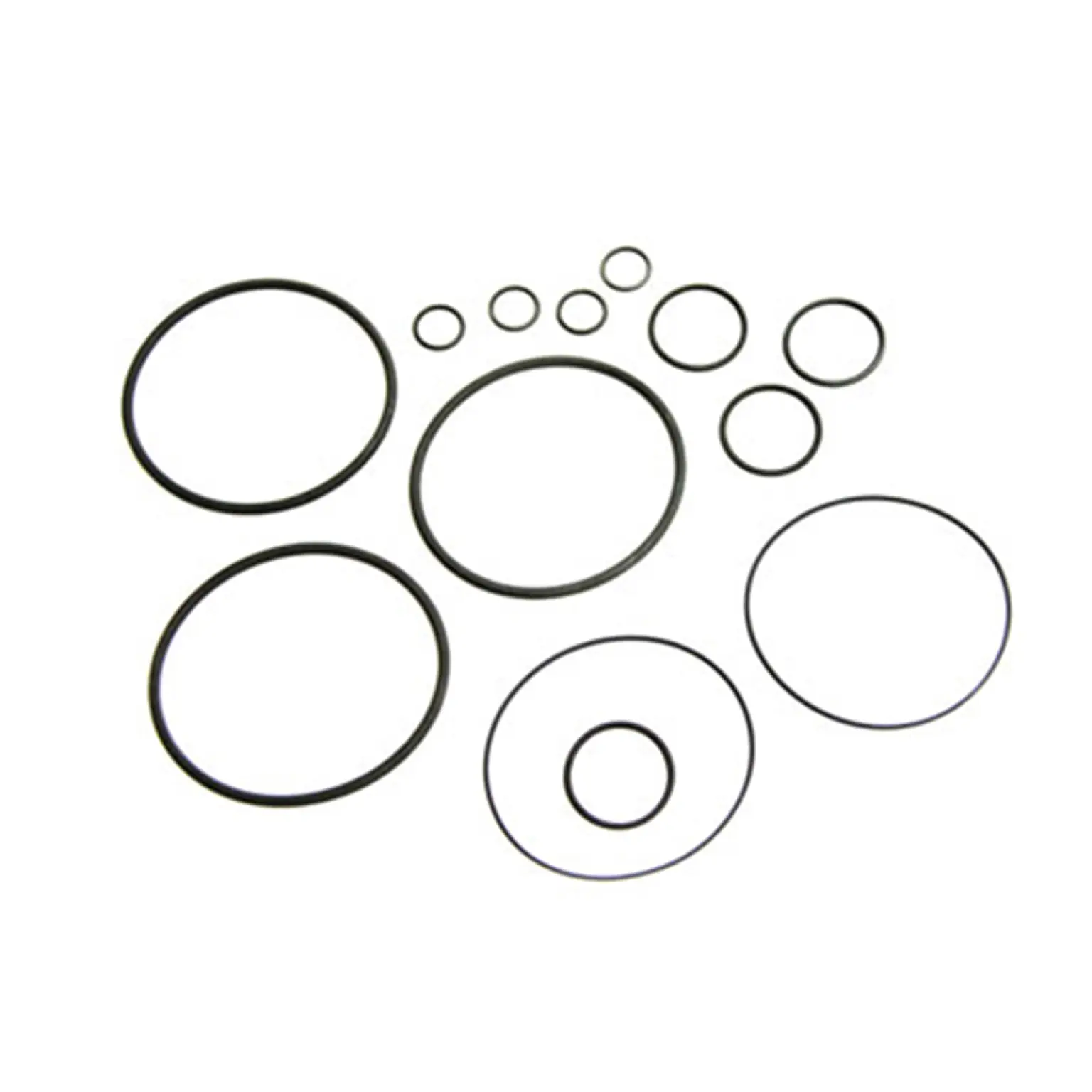
The O-ring is the most basic seal, assembled in the groove and brought into contact with the perturbation surface by compression, and has a sealing force due to repulsive elasticity. First, like a piston or a rod seal, there is a radial seal that is pressed against the inner and outer diameters, and second, there is an axial seal or face seal where the top and bottom surfaces are pressed against each other. The O-ring is pressed at the same time as assembly, automatically forming a sealing force, especially for fixed use.
O-rings are primarily used to prevent the loss of a fluid or gas. However, O-rings can be used as dust seals, drive belts or on rotating shafts. Most O-ring seals can be classified into of the three arrangements shown below.
| Elastomer Type | Durometer | Temperature Range | Service |
|---|---|---|---|
| Nitrile | 70+/-5 | -40℃ to 120℃ -40℉ to 248℉ | A general service Nitrile compound for a wide range of applications including petroleum based fluids. Nitrile compounds also have excellent resistance to compression set, tear and abrasion resistance. |
| Nitrile | 90+/-5 | -25℃ to 120℃ -13℉ to 248℉ | Generally used for higher pressures than the 70 durometer materials, while having comparable media resistance. |
| High Saturated Nitrile | 70+/-5 | -40℃ to 150℃ -40℉ to 302℉ | This is a hydrogenated Nitrile compound which provides the material with improved resistance to heat, ozone and aging. Similar applications to Nitrile but with improved mechanical properties and media resistance. Excellent for many oilfield and automotive applications. H2S resistance up to10%. |
| High Saturated Nitrile | 80+/-5 | -40℃ to 150℃ -40℉ to 302℉ | Generally used for higher pressures than the 70 durometer materials while having comparable media resistance. |
| High Saturated Nitrile | 90+/-5 | -40℃ to 150℃ -40℉ to 302℉ | Generally used for higher pressures than the 80 durometer materials while having comparable media resistance. Improved ED resistance. |
| VitonⓇ | 75+/-5 | -25℃ to 204℃ -13℉ to 400℉ | Genuine VitonⓇ compounds have excellent resistance to ozone, weather, oxygen, mineral oil, fuels, hydraulic fluids, aromatics, petroleum fluids, many organic solvents and chemicals. VitonⓇ is also used in high temperature applications. VitonⓇ ExtremeⓇ TBR and ETP compounds are also available. TBR- Totally Base Resistant compound that provides improved performance over other TFE / Propylene polymers. ETP- Provides the excellent thermal resistance of VitonⓇ along with significantly advanced chemical resistance. |
| VitonⓇ | 80+/-5 | -25℃ to 204℃ -13℉ to 400℉ | Genuine VitonⓇ is generally used for higher pressure than the 75 durometer materials while having comparable media resistance. |
| Perfluoroelastomer | 75+/-5 | -15℃ to 300℃ 5℉ to 572℉ | Perfluroelastomer materials combine the best heat and chemical resistance performance compared to other elastomer materials. |
| Perfluoroelastomer | 75+/-5 | -4℃ to 230℃ 25℉ to 466℉ | Generally used for higher pressures than the 75 durometer materials while having comparable media resistance. |
| Aflas™ | 80+/-5 | 0℃ to 230℃ 32℉ to 466℉ | Tetrafluoroethylene-Propylene materials exhibit exceptional thermal and chemical resistance including hot water, steam, acids, alkaline solutions, ammonia, amines, brake fluids, petroleum fluids and sour gas. Low temperature may restrict sealing abilities. |
| Neoprene | 70+/-5 | -45℃ to 135℃ -49℉ to 275℉ | Neoprene is a general purpose material for refrigerants, ozone and weather. |
| Etylene-Propylene | 70+/-5 | -54℃ to 150℃ -65℉ to 302℉ | Ethylene-Propylene materials exhibit excellent resistance to water, steam, brake fluids and ozone. |
| Etylene-Propylene | 80+/-5 | -54℃ to 150℃ -65℉ to 302℉ | Generally used for higher pressures than 70 durometer EPDM compounds while having comparable media resistance. |
| Silicone | 70+/-5 | -55℃ to 230℃ -67℉ to 446℉ | Silicone compounds offer the widest elastomer temperature range but typically can not be used in dynamic applications or petroleum based fluids. |
| Fluorosilicone | 70+/-5 | -55℃ to 200℃ -67℉ to 39℉ | Fluorosilicone for use in petroleum and synthetic oils, greases, amines, amine- treated hydrocarbons and steam |
Since our founding in 1993, we have remained at the forefront of the sealing industry.
30 Years in Construction Chemicals & Industrial Sealing Solutions.
Expert Consultation and Responsive Support
Since our establishment in 1993, we have prioritized seamless communication with our global partners.
1157, Gijang-daero, Ilgwang-eup,
Gijang-gun, Busan, 46047, South Korea
+82-70-7510-2039
psg@dongsuhco.com